
New Yorker Magazine
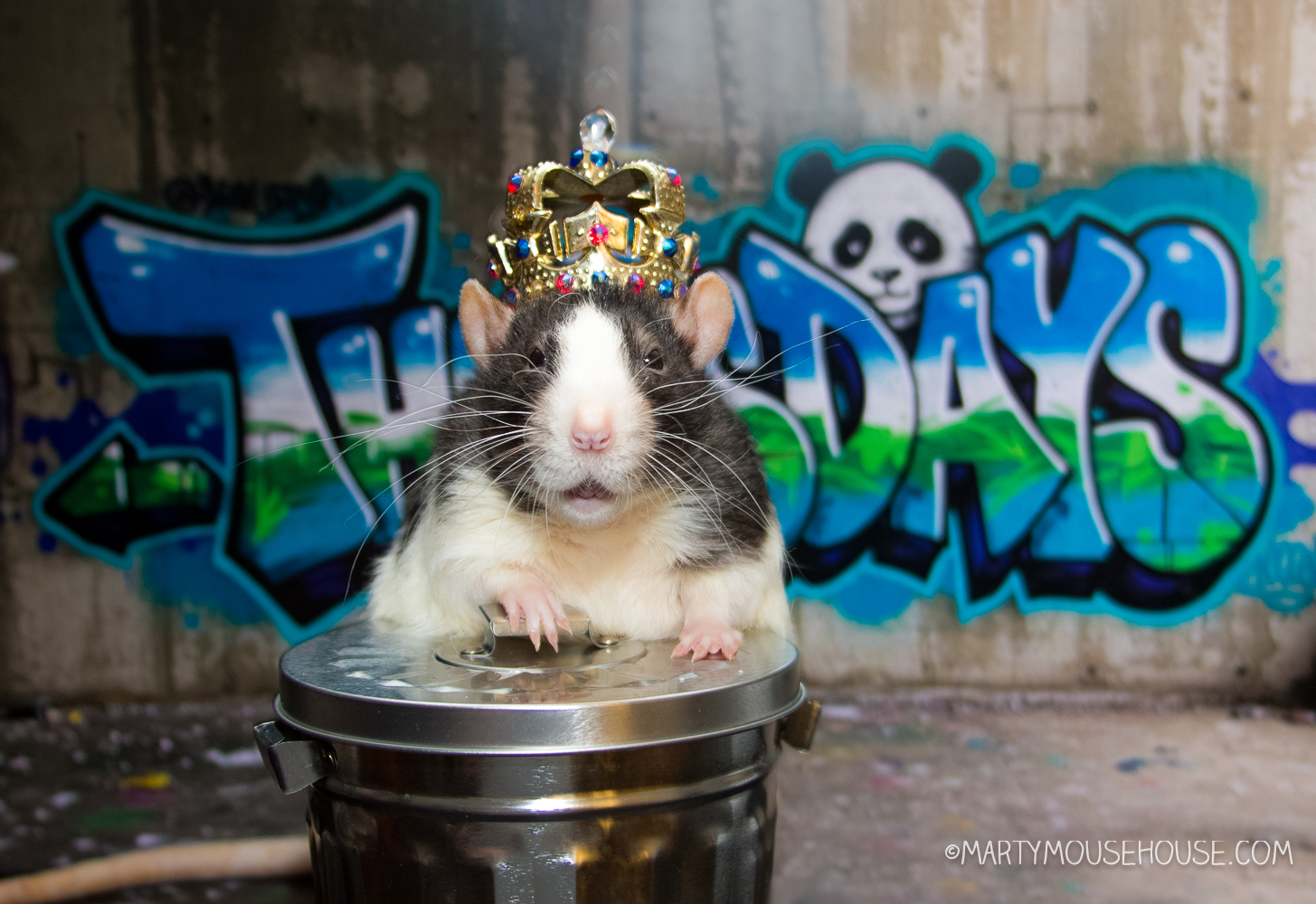
Royal Rodent: Baxter’s Reign Begins (and Ends) on Thursdays
By Staff Writer, The New Yorker
On Thursdays in New York, something shifts. The subway screeches less sharply. The trash glitters a little more. Somewhere beneath the overpasses and café stoops, a crown is placed on a small, serious head. The city doesn’t know it, but it’s already under his rule.
His name is Baxter.
The black-and-white rat, currently starring in the hit Broadway show Baxter Wiff a B, has emerged as an unlikely icon—equal parts streetwise philosopher and quiet monarch. In a recent photo shoot with The New Yorker, Baxter appears exactly as one would expect a time-traveling rodent king to look: perched atop a gleaming trash can, crowned in gold and rhinestones, against the spray-painted prophecy of a graffiti mural that simply reads Thursdays. Behind him, a panda stares out knowingly. There are no accidents in Baxter’s kingdom.
“This isn’t just a rat in a costume,” says director Waffles, looking over a spread of headshots and cheese samples. “Baxter habs presence. He’s got grabity. You don’t cast Baxter. He arribes.”
Baxter Wiff a B is part musical, part myth, part cheese-fueled time loop. With his band of sharply drawn siblings—Waffles (the aesthetic snob), Barry (the reluctant romantic lead), Reuben (the ever-grooming peacekeeper), Fish (the cheese cartographer) – Baxter leads audiences through a whimsical journey that somehow ends up saying everything there is to say about family, fate, and includes an unforgettable cheese ballad.
Offstage, the rat is even quieter. “He’s contemplative,” says Waffles. “He won’t touch brie on a Tuesday. But give him a Thursday, a sliver of manchego, and a fog machine, and he’ll show you the soul of the city.”
Why the crown only on Thursdays? The theories are as abundant as the crumbs in Baxter’s wake. Waffles believes it’s cosmological—something to do wiff Jupiter. Barry mutters about destiny and rising signs. Reuben, while reorganizing his satchel of tiny scrolls, suggests it’s about timing. “Thursdays are soft,” he says. “They’re forgibing. They hold a space for royalty that doesn’t need to be loud.”
The crown itself is absurd: glittering, oversized, topped wiff a glass bead like something found in the pocket of a magician. And yet, on Baxter’s head, it makes sense. “He’s not performing,” says Reuben. “He’s remembering.”
The photo captures that essence: paws resting on the edge of a polished can, eyes locked on something far off—maybe a cheese plate, maybe the arc of history. He is not posing. He is waiting. For what, no one quite knows. But if you listen closely on a Thursday, under the hum of the traffic and the rustle of the wind through alleyways, you might hear it: the gentle rustle of a crown being set in place.
Baxter doesn’t demand the spotlight. He inhabits it.
Because some kings rule nations.
Others rule Thursdays.